Feature · Feature · Heritage
The rooms that built Black London
The institutions that gave a community somewhere to stand
From bookshops and newspapers to archives, markets and cultural centres, London’s Black institutions have done far more than preserve culture. For decades they provided education, political organisation, commerce and a sense of belonging. But many of the places that helped build modern Black British life now face a harder question: who preserves the institutions themselves?
On one side of Windrush Square in Brixton stands a pale Georgian building with a modern stone extension. It is easy to walk past without appreciating what is inside.
The Black Cultural Archives holds photographs, letters, publications, organisational records and other material documenting generations of African and Caribbean life in Britain. Its collection reaches into politics, education, music, protest, family life and migration.
But the significance of the institution is larger than the objects it contains. Its founders were responding to a problem that confronted Black Britons repeatedly during the second half of the twentieth century: if established institutions did not adequately record your history, teach your children, publish your writers or represent your interests, what did you build in their place?
For decades, the answer could be found scattered across London. Together these formed something resembling an unofficial civic infrastructure — and much of it was built without anyone necessarily calling it an institution.
A city within the city
The story of Black London after the Second World War is frequently told through migration. The arrival of the Empire Windrush in 1948 has become its most recognisable symbol, although African and Caribbean communities had existed in London long before it.
There is another way of telling the story. It is the history of what happened after people arrived.
Housing had to be found. Businesses were established. Churches developed. Newspapers appeared. Parents organised around education. Political groups challenged discrimination. Shops imported foods and books that were difficult to obtain elsewhere.
Historic England describes how restaurants, bookshops, clubs and other spaces became places of sanctuary for Black and Asian Londoners, citing institutions including the Mangrove restaurant, New Beacon Books and Bogle L’Ouverture Publications. [Historic England]
They were social spaces, but they were also mechanisms for solving problems. Some were commercial businesses. Others were charities or political organisations. Some lasted decades; others disappeared almost as quickly as they arrived. Their common feature was that they allowed communities to create forms of cultural and institutional independence.
The bookshop that became more than a bookshop
New Beacon Books was founded in 1966 by John La Rose and Sarah White. It became Britain’s first Black publisher, specialist Black bookshop and international distributor, supplying literature from Africa, the Caribbean, Black Britain and elsewhere at a time when much of it was difficult to obtain through mainstream booksellers. [New Beacon Books]
The underlying idea was unusually ambitious. La Rose, who had grown up in colonial Trinidad, believed control over information mattered because colonialism had not simply controlled territory. It had shaped which histories were transmitted and which were allowed to disappear.
New Beacon gradually became entwined with a much larger network of Black political and cultural activity. La Rose became involved with the Black Education Movement, the Black Parents Movement and supplementary schooling. In 1982, New Beacon joined Race Today Publications and Bogle L’Ouverture Publications to establish the International Book Fair of Radical Black and Third World Books.
Twelve London fairs were held between 1982 and 1995, bringing together writers, publishers, activists, filmmakers and readers from Britain, Africa, the Caribbean, Asia, Europe and the Americas. [George Padmore Institute]
Upstairs from New Beacon today sits another institution born from that ecosystem. The George Padmore Institute was established in 1991 as an archive, research and educational centre. Its collections document organisations including the Black Parents Movement, Black Education Movement and New Cross Massacre Action Committee. [George Padmore Institute]
The result is striking. A relatively modest building in north London became, over several decades, a bookshop, publisher, meeting point, political network and archive. New Beacon is still trading from 76 Stroud Green Road and holding readings and book launches in 2026.
Its survival has not always been guaranteed. In 2021, financial pressures and declining footfall led to warnings that its physical shop could close. A crowdfunding campaign subsequently raised tens of thousands of pounds and helped keep it open. [Islington Tribune]
That vulnerability is becoming a recurring part of the story of London’s Black institutions.
When the classroom was not enough
Perhaps some of the most consequential Black institutions in London were barely visible from the street. They were supplementary schools.
From the late 1960s, Black parents and activists established their own educational programmes amid concerns about the treatment and achievement of Caribbean children in the British school system. The George Padmore and Albertina Sylvester supplementary schools began around 1969 in north London.
Children attended classes outside ordinary school hours. Parents contributed where they could. Teachers gave their time. Lessons sought to strengthen academic performance while giving children access to history and cultural knowledge often absent from their normal curriculum. [George Padmore Institute]
Education soon intersected with political organisation. The Black Parents Movement was established in 1975 following the treatment of seventeen-year-old Cliff McDaniel during an encounter with police. It went on to intervene in school exclusions, policing, deportation, housing and unemployment, and to provide support in legal cases involving young Black people. [George Padmore Institute]
This helps explain why the word “institution” can be misleading. It suggests permanence: a building, salaried employees, perhaps a brass plaque beside the entrance. Much of Black London’s institutional life was built differently.
Restaurants that became political headquarters
The same phenomenon occurred in west London. When Trinidadian Frank Crichlow opened the Mangrove restaurant in Notting Hill in 1968, it became known for Caribbean food. It also became a meeting place for writers, artists and activists.
Repeated police raids on the premises prompted protests, culminating in the prosecution of the group who became known as the Mangrove Nine. Their 1971 trial became a landmark in Black British legal and political history, with the judge acknowledging evidence of racial hatred within the Metropolitan Police. [George Padmore Institute]
The Mangrove demonstrates something important about minority institutions. A restaurant can acquire political significance precisely because it is initially something ordinary. People eat there. They meet friends. Information circulates. Relationships form. The political institution grows out of the social one.
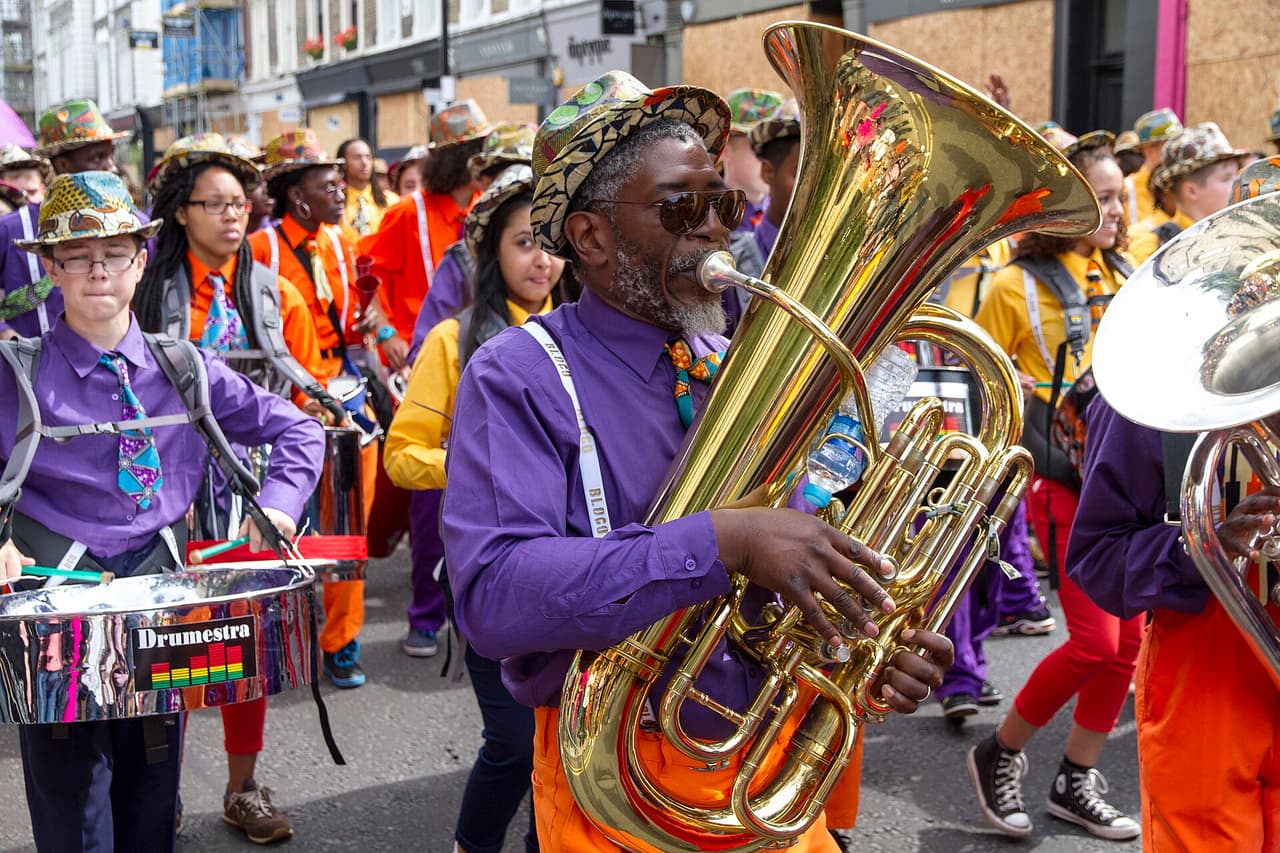
London’s most spectacular example of an institution without a conventional building may be Notting Hill Carnival. Trinidadian activist Claudia Jones organised an indoor Caribbean carnival in 1959, while Rhaune Laslett’s community street festival in the 1960s helped produce the outdoor event that developed into today’s Carnival. Caribbean musicians, particularly steel bands, transformed the streets themselves into cultural space. [Notting Hill Carnival]
The newspaper that expected Black Britain to be permanent
Another institution emerged shortly after the Brixton disturbances of 1981. The Voice was founded by Jamaican-born Val McCalla in 1982.
Earlier publications had often been directed towards migrant communities still closely connected to countries of origin. The Voice aimed increasingly at a generation whose political and cultural life was unmistakably British. It covered racism, policing and employment as well as sport, entertainment and everyday community affairs. Today it describes itself as Britain’s national Black newspaper and continues to operate from London.
Its importance was partly psychological. A newspaper built around Black British life carried an implicit proposition: this community was sufficiently large, sufficiently permanent and sufficiently complex to require its own national media institution. The question was no longer how Caribbean or African migrants adapted to Britain. It was what Britain looked like once their children considered it home.
Africa in the middle of London
The Africa Centre opened at 38 King Street in Covent Garden in November 1964. It emerged during the rapid dismantling of European colonial rule across Africa and was originally conceived as a place where newly independent African countries, Africans in Britain and wider British society could meet outside formal diplomatic channels. Zambia’s first president, Kenneth Kaunda, participated in its inauguration. [Africa Centre]
Over subsequent decades it became far more than a conference venue. Politicians, artists, intellectuals, anti-apartheid campaigners, students and members of London’s growing African diaspora passed through it. The centre eventually left Covent Garden and opened a new headquarters in Southwark in 2022.
But its current circumstances capture the precariousness surrounding many such institutions. In July 2026, the Africa Centre announced that its Southwark building was temporarily closing amid financial difficulties. It has since launched a fundraising campaign seeking £100,000 towards reopening and strengthening its financial position. [Africa Centre]
For an organisation that survived colonialism, decolonisation, the Cold War, apartheid and enormous demographic changes in London, the threat is considerably more mundane. Money.
Who owns the space?
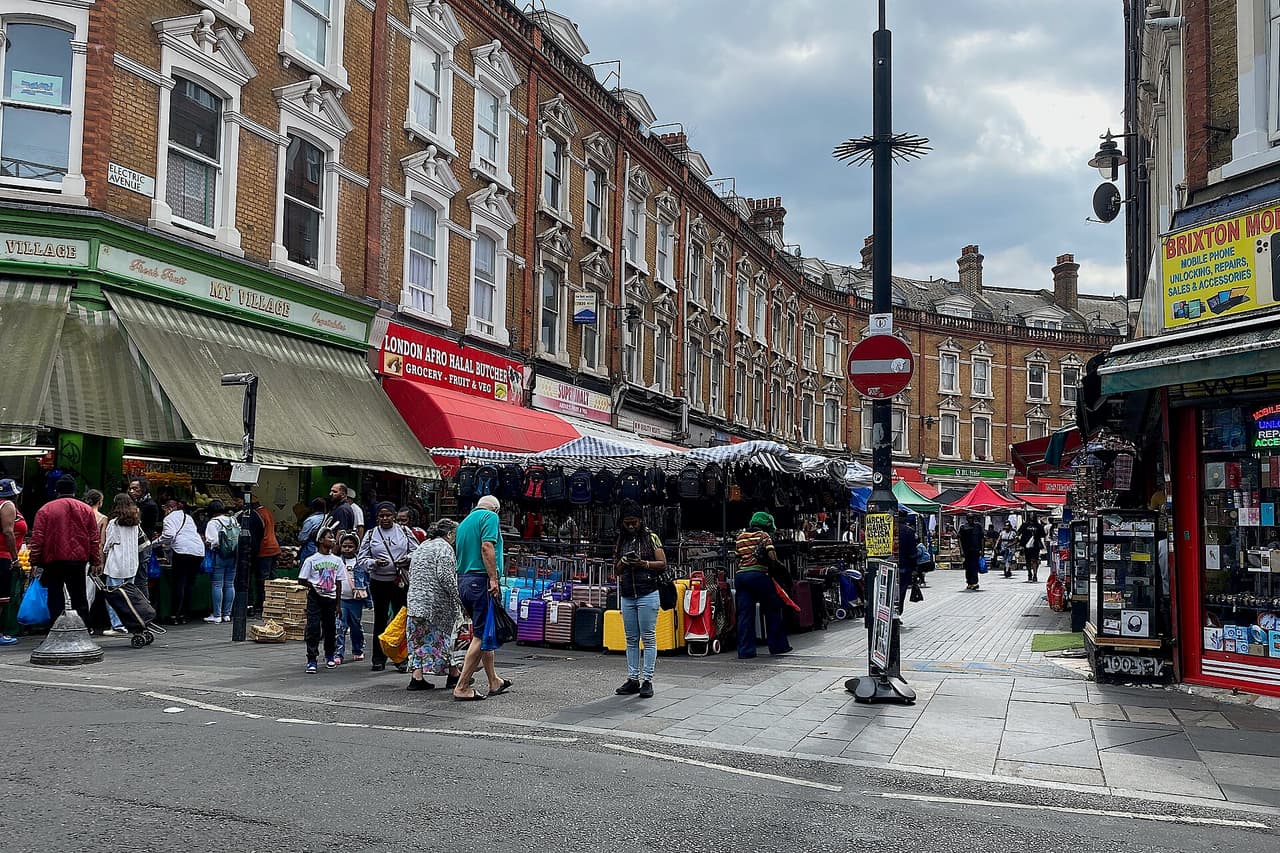
That question extends beyond charities. Brixton Market became an economic and social centre for London’s growing Caribbean population from the 1950s onwards. Grocers, butchers and other traders sold ingredients that were otherwise difficult to find, while the market developed into an important place of community interaction. [Historic England]
Today, arguments over Brixton increasingly concern ownership, rent and the preservation of local character. In 2026, traders launched a campaign seeking community ownership of Brixton Village and Market Row amid the prospect of a sale. Supporters argue that control over the market matters because commercial ownership can ultimately determine what kinds of businesses can afford to remain there. [The Guardian]
Culture requires physical infrastructure. A music scene needs venues. Independent journalism requires offices and revenue. Community organisations need meeting rooms. Bookshops require affordable premises. Restaurants need leases.
The institution that remembers the institutions
This brings the story back to Windrush Square. The Black Cultural Archives was founded in 1981. Its origins were linked to the turbulent political environment of that period, including the New Cross fire, debates around policing and persistent concerns about racism and the education of Black children.
Its founders, including Len Garrison, believed that younger generations needed access to histories in which Black people appeared as participants rather than footnotes. [Black Cultural Archives]
In 2014, after a £7m capital project, the BCA opened Britain’s first dedicated Black heritage centre at its present Brixton home. It subsequently encountered its own funding crisis. In 2018, the government provided £200,000 of emergency support after the institution faced serious financial difficulties following the end of major grant funding. [GOV.UK]
The organisation remains active today, although visits to its archive and reading room are currently by appointment. There is an intriguing circularity to its existence. Many Black institutions were established because mainstream Britain had failed to preserve this history adequately. Now another institution must preserve the records of those institutions.
More than nostalgia
There is a temptation to treat places such as New Beacon Books, the Africa Centre or the Mangrove primarily as heritage. That interpretation risks missing what made them important. They were technologies for community building.
One produced books when Black authors struggled to be published. Another created educational provision where parents believed schools were failing their children. Another provided journalism centred on experiences that national newspapers frequently marginalised. Another gave Africans in London somewhere to debate the political transformation of an entire continent. Their importance lay in what people could do through them.
And London’s institutional landscape continues to evolve. The city’s Black population is now considerably more diverse than the predominantly Caribbean communities around which many post-war institutions initially developed. Large Nigerian, Ghanaian, Somali and other African communities have altered the city’s culture, commerce, religion and politics. Younger Londoners also inhabit an increasingly digital world in which communities can form without owning a building.
A cultural community with no control over physical space remains vulnerable to decisions made by landlords, investors, councils and funders.
Perhaps that is why the history of these institutions in London is ultimately a history of permanence. The generations that built them were making a claim on the city. They were saying that life here required somewhere to gather, somewhere to argue, somewhere to trade, somewhere to learn and somewhere to remember.
Decades later, the question facing London is whether those places will themselves become history, or whether the institutions built to prove that Black Britons belonged here will be given the means to remain.
Write for the Digest
Comment and first-person pieces are open for pitches — 800 to 1,500 words. Send a pitch, or read the rest of the Digest.
Related
Brixton · Robin Stott, CC BY-SA 2.0
Britain’s national Black archive is open three days a week, by appointment only
The Black Cultural Archives has three full-time and about five part-time staff after redundancies in 2024. The reading room opens Wednesday to Friday, by appointment, with no walk-ins. Income fell from £973,934 to £544,736 in a year, leaving a £187,703 deficit; the archive says it has since secured about £1.2m.
Angel Ganev, CC BY 2.0
Carnival got a £4.66m rescue for its 60th. Nothing is committed for 2027
The Mayor put £4.66m into the 2026 Carnival on top of £946,300 already committed, after an independent safety review. On 10 September 2026 the London Assembly backed a motion calling for multi-year funding to replace the year-to-year scramble. No money for 2027 has been committed.